

- The Truth About Progress: It’s Not Linear (And That’s Okay)
- Training Smarter Beats Training Harder
- You’re Probably Not Eating Enough (Even If You Think You Are)
- Sleep Isn’t Optional. It’s Your Secret Weapon
- Sleep hacks that work:
- The Mind-Muscle Connection Is Real — but Often Neglected
- Supplements Are Overrated (But a Few Do Help)
- Your Hormones Play a Bigger Role Than You Think
- Social Media Is Lying to You—Don’t Compare
- Real Gains Require Real Patience
You’ve probably come across the popular WellHealth how to build muscle tag in your quest for fitness knowledge. It promises clarity, actionable steps, and muscle growth made simple. And yes, it covers the basics—train hard, eat enough protein, sleep well. But here’s the thing: there’s a lot it doesn’t tell you.
Because building real, lasting muscle isn’t just about a checklist. It’s about understanding the why behind every rep, the science behind the food, and the mental discipline that separates temporary gym-goers from true transformers.
In this article, we go beyond the surface. Consider it the unfiltered version—the stuff you won’t find in your average “how to build muscle” guide. Let’s unlock your gains, once and for all.
The Truth About Progress: It’s Not Linear (And That’s Okay)
The first thing the WellHealth how to build muscle tag doesn’t emphasize enough is that progress is non-linear. You might gain 2kg of lean mass in a month, and then stall for the next six weeks. That’s completely normal.
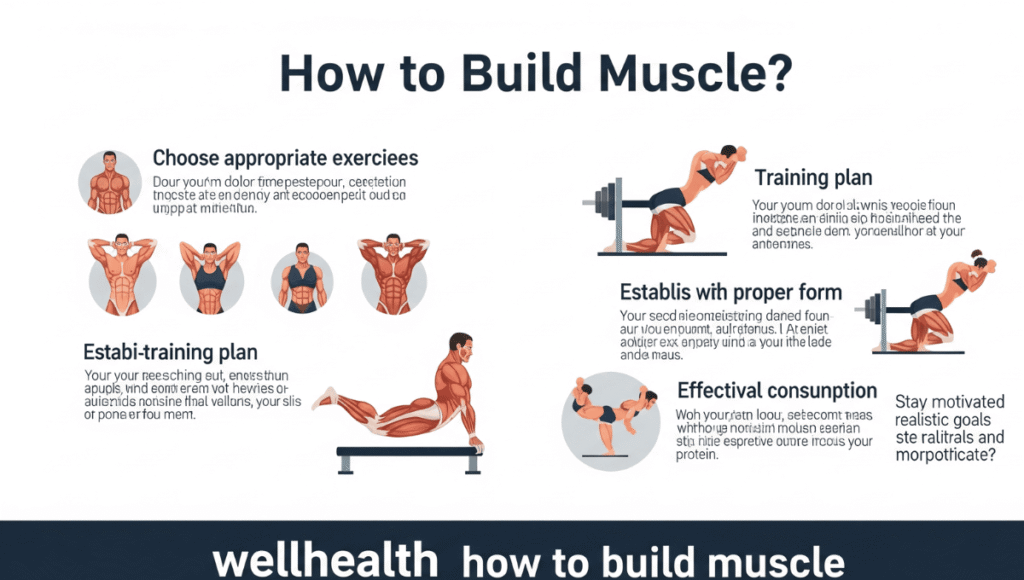
Your body is adjusting all the time, sometimes it’s healing, at other times, rebounding and sometimes it’s resisting change. Not that there’s anything wrong with your progress.
What to do instead:
- Maintain a long-term outlook (think in 6- to 12-month terms, not 6 weeks).
- Measure your body and take photographs, every four weeks — not every day.
- Stay consistent even when visible results seem slow.
Training Smarter Beats Training Harder
The tag will tell you to lift heavy. Sure. But here’s what it misses: smart programming beats brutal effort.
You don’t need 2-hour workouts or 6-day splits. What you need is:
- Progressive overload (slowly increasing weight or reps)
- Time under tension (don’t rush your reps — control them)
- Good form (full range of motion and contracting the correct muscle)
For instance, 8 perfect Romanian deadlifts at moderately heavy weight will send a stronger growth signal in your hamstrings than 1
You’re Probably Not Eating Enough (Even If You Think You Are)
Most beginners severely underestimate how much food they need to gain muscle, especially when training intensely.
Yes, nutrition is covered in the WellHealth how to build muscle tag, but here’s the reality: a slight calorie surplus is non-negotiable if you want gains. Not “clean eating.” Not low carb. Not intermittent fasting.
Actionable advice:
- Use a free calorie calculator to find your maintenance level.
- Eat 250–500 calories above maintenance for lean muscle gain.
- Prioritize whole foods, but don’t fear carbs or fats.
Sleep Isn’t Optional. It’s Your Secret Weapon
We all know sleep is “important,” but do you realize just how critical it is for muscle growth? The WellHealth tag mentions rest, but here’s the deeper truth:
- 90% of muscle repair and hormone regulation happens while you sleep.
- Less than 6 hours of sleep on a regular basis will lead to a tanking testosterone and a spike in cortisol…two muscle killing hormones.
- That’s not something you’re going to fix with protein powder or pre-workout.
Sleep hacks that work:
- Keep your room cool and dark.
- Stay off of screens for 30 minutes before bed.
- Go to sleep and wake up at the same time every day, including weekends.
The Mind-Muscle Connection Is Real — but Often Neglected
The tag may recommend specific exercises, but it rarely explains the most overlooked principle: you must feel the muscle working.
This is what bodybuilders call the mind-muscle connection, and it’s a game-changer. Don’t just lift—focus deeply on the exact muscle you’re trying to engage.
Here’s an example:
When doing bicep curls, avoid swinging the weight. Instead, squeeze at the top. Pause. Lower slowly. Think about the bicep contracting.
The result? Better activation, less joint stress, and faster growth.
Supplements Are Overrated (But a Few Do Help)
The WellHealth how to build muscle tag sometimes implies that supplements are necessary. In reality, they’re optional and should only be used to support, not replace, your diet.
Here’s what’s worth your money:
- Creatine monohydrate: Backed by over 1,000 studies. Safe and effective.
- Whey protein: Convenient for hitting your daily protein goal.
- Vitamin D & Magnesium: Common deficiencies that impact performance.
Skip the fat burners, “mass gainers,” and magic powders. They’re mostly marketing.
Your Hormones Play a Bigger Role Than You Think
Here’s something nobody talks about: you’ll want to ensure good hormone health if you want to grow muscle. Your body can’t build muscle as effectively if your testosterone, cortisol, or insulin are out of whack, even if you do everything else perfectly when it comes to training and nutrition.
How to support healthy hormones naturally:
- Lift weights (especially compound exercises that recruit a lot of muscles).
- Get a good night’s sleep, and lower your stress.
- Eat fats—yes, dietary fat supports testosterone.
- Avoid chronic calorie restriction or overtraining.
Social Media Is Lying to You—Don’t Compare
Instagram and TikTok are filled with people showing off six-packs, massive arms, and “90-day transformations.” Most are:
- Using filters or lighting
- On performance-enhancing drugs (PEDs)
- Sharing only the highlights—not the years of hard work
The WellHealth how to build muscle tag won’t warn you about the mental trap of comparison. But we will: Focus on your own journey.
Track your own progress. Be your own competition.
Real Gains Require Real Patience
If you want shortcuts, you’ll be disappointed. But if you’re prepared to treat this as a lifetime commitment, you will be astonished by what your body is capable of doing in one year, or two, or five.
The fittest, most svelte, most confident people you know don’t have freakish genetics, they’re just excluded, unwaveringly consistent.
Final Thoughts About the True Power of the WellHealth How to Build Muscle Tag
The WellHealth how to build muscle tag is a good place to start. But if you want to unlock significant gains in reality, you
- Focus on smart training, not just hard training.
- Prioritize recovery just as much as lifting.
- Eat enough—fuel is not optional.
- Develop awareness, discipline, and mental strength.
Your transformation starts when the excuses end.
So, if you’re truly ready to grow stronger—in body and mindset, don’t just read the WellHealth how to build muscle tag. Live it. Own it. Expand on it.


